Friday, April 22, 2011

Sermon for Good Friday, 2011 "What is Truth?"

We hear the story once again of Jesus’ arrest, trial, and death today. We know what happens. We know how it ends. It is clear, with the gift of our hindsight, to see what evolved. They were strange bedfellows, the religious leadership who distrusted and disliked Jesus’ message and growing following among the common people, and the Roman power structure, always aware and on the lookout for those who would threaten their stranglehold on the people.

They came together in a political relationship to deal with this problematic rabbi who reinterpreted the ancient texts in disturbing ways.

And at the crux of that relationship was one man: Pontius Pilate. Pilate was the head of the Roman Empire’s government in Judea during Jesus’ time. His title was “Prefect,” or governor. At the heart of his work was to make sure that things ran smoothly despite the crushing taxation of the people of Judea in that era. The funds needed to be collected and opposition to Rome needed to be quashed.

Pilate had no real quarrel with allowing the Jews to observe their religion, although they were supposed to pay homage to Tiberius Caesar as a god. He saw no reason to fight that battle, and worked with the ethnic and religious leadership, notably the Sanhedrin and Caiaphas, the High Priest, in an uneasy alliance. Like many colonial governors, he wanted nothing more than a calm reign as governor and a transfer back to Rome and something more elevated than running a backwater nation in the desert heat.

But he got something else entirely. These argumentative Jewish leaders had what they considered a problem on their hands: Jesus of Nazareth, whom some called the Messiah, the Son of God. Well, if this Jesus fellow made that assertion, Pilate had a problem, because only Caesars were gods. The Sanhedrin might think this was a blasphemy, but to Pilate this was something worse: this was treason.

He had to dispatch this quickly, because the crowds were thick in Jerusalem during the Passover festivals, and he didn’t want any disorder that might be reported back to Rome.

Good thing there was a process to handle such matters. Pilate was an orderly man, and he liked processes. Nothing left to chance, just follow the process and all could be safely dealt with. The Jewish leaders had arrested the man and questioned him, a grand jury of sorts, and found that he was in violation of their laws. They couldn’t quite specify which laws of course, and Pilate was not in the business of worrying about their myriad religious rules, which seemed to number in the thousands, but one must assume that there was some legitimacy to their complaints. So they dragged him before Pilate, to be dealt with under Roman law.

Pilate looked at him. He didn’t look like any wild-eyed radical. Just another Jew in the city, a bit bedraggled by his rough handling by the guards. But he also didn’t look frightened, which was disturbing. Why wouldn’t he be frightened, facing the might of the empire?

But he simply stood there, flanked by the overwrought priests, who wouldn’t even go into Pilate’s palace. Annoying, this. Pilate had had to go out to talk with them. If he ignored them, who knows what mischief they would get into?

They were insisting that this man had done something so awful he deserved to die. Pilate thought, “Oh, the dramatics. By Jupiter, I wish they would just tend to this themselves.” But asserting his power was part of his job, so he asked them what he had done…and they simply dodged the question, saying, “We wouldn’t have brought him here if he wasn’t a criminal.”

Pilate looked at them. One strangely calm, slender, sad-eyed man. A bunch of angry priests. “Deal with him yourselves.”

“We cannot. By our religion, we cannot execute him.”

Pilate thought, “Damn them. They want me to do their dirty work.” Sighing, he said “I will examine him.”

So Jesus was brought into Pilate’s palace and the governor questioned the rabbi. But it was an unsatisfying interrogation. The man simply answered questions with riddles, with odd comments that didn’t seem to add up to an actionable offense. Perhaps he was just another religious reformer – the gods knew that this Jewish religion always had someone who was trying to reform something or other – but nothing seemed to rise to the level of a violation of Roman law. And then came the last exchange: Jesus said, “Everyone who belongs to the truth listens to my voice.”

And Pilate, frustrated by this strange exchange, blurted to him, and to those in the room “What is truth?”

Was the truth what the Sanhedrin said, that this man should die for his misdeeds?

Was the truth what Jesus said, which seemed to allude to his special status, in which case there really was a problem?

Was the truth the political juggling game that Pilate always had to play, balancing the interests of Rome and Jerusalem with his own future?

What was the truth that would preserve his authority and his position, and get him safely back to Rome?

But John’s gospel does not reveal if Jesus replied to Pilate’s cynical question.

We think not, because Pilate then decided he would leave this Jewish man’s fate not to the state, but to the people. Dangerous business to be sure – one never knew exactly how the people would act, particularly in the midst of political tension and the excitement of the festival – but easier than making a decision oneself, especially when the decision could cause him professional harm.

And something about the man unsettled him – better not to deal with it himself, but to do it in a way that revealed imperial power and even, one might say, generosity.

He went out and asked the people, “Your kind and generous Roman governor has a gift for you, dear people. Shall I give you this bandit, Barabbas, or this fellow who is said to be King of you Jews?”

He knew the politics of it...he expected that the religious leaders would have stirred up the people against Jesus. He was right. They crowed “Barabbas! Give us Barabbas!” despite the fact that they would have cowered in the shadows if they saw Barabbas approaching them in an alley.

What is truth? Did they really want Barabbas and not this man they had hailed as their king a few days before?

Ah, well, it didn’t matter. They had made the decision for him as he wished. But being an adroit politician, covering all possibilities, he decided to press the matter.

“I find no case against him.”

What is truth?

They cried out “Crucify him!”

What is truth? The vicious cry of the crowd? Did that make Jesus guilty?

Pilate said, “There is no case. You deal with him.”

Truth, that, but not a truth they wanted to hear.

They cried “He broke our law and we cannot execute him, so you must do it.”

The hammer of truth was crashing on Pilate’s temple, and he could not evade it.

He brought Jesus back in, a Jesus who was now bearing the marks of a beating at the hands of the soldiers, standing a bit more bent now.

What is truth? Pilate kept questioning him. “Where are you from? Why will you not speak? Why will you not answer these charges?” In his mind, Pilate thought, “Give me truth. Give me a reason not to kill you. Let’s do this the easy way.”

But Jesus gave him his truth, and Pilate was caught in its vines. The truth did not set Pilate free, it required him to continue to act in a play that he could not control. And now the religious leaders were saying that Jesus claimed to be a King, and Pilate must execute him or be guilty of treason against the empire himself.

What is truth? That empires have power? That earthly power is a curse, not a prize?

The ignominy of Pilate’s powerlessness in the face of this situation was matched by the blasphemy of the chief priests who cried out “We have no king but the emperor.”

The truth was Pilate was doomed.

The truth was that they all were doomed.

Jesus, crucified on the cross, as had always been required of him.

The religious leaders, betrayers of their own people as well as their God.

Yes, Pilate, perhaps he most of all. He had tried to manage history. He had tried to manage God. He had sensed something beyond the messy politics of the moment, something in this man brought before him, and wanted nothing of the man’s death. But he was a player in God’s work, and he was doomed to act as was required of him.

We ourselves ask “What is truth?” We want to hear the answers that salve our hearts, the easy answers. But there is only one truth, and it is an uncomfortable one.

The truth is we were doomed, until Jesus died on the cross for us.

The truth is we pretend we are in control of our lives, when it is only by God’s grace that we live.

The truth is that we owe far more to God than we can ever repay.

So we need to hear Pilate’s story, his hubris and his downfall, because it is our own. We too try to dodge an honest look at our own participation in the failures of this world. We too worry more about the effect our choices have on our position in the world than about what is right and good. We too think that we are in control, when we are players in an eternal drama beyond what we can comprehend.

That is truth, and it behooves us to look upon Jesus on the cross and say “You are truth. Thank you for what you suffered. Help me.”

Pray for the courage to face our own truths in our lives. Pray for the strength to change.

Amen.


An mp3 audio version of this sermon can be found here.

Thursday, April 21, 2011

Sermon for Maundy Thursday, April 21, 2011 “The Taste of Memory”


It is an unusual occurrence that Passover and Holy Week are concurrent this year. At their Passover meal, the seder, our Jewish brothers and sisters retell the story of their exodus from Egypt. They read the Haggadah which recounts the story, and organizes the sacred meal, with instructions to the letter as to what to eat and how to eat it. How can we not hear this Old Testament passage this evening and remember how that meal was at the heart of the final meal that Jesus ate with his disciples? And how can we not remember his words “do this in remembrance of me,” just as the Lord said to Moses “This day shall be a day of remembrance for you.”

Meals are at the heart of remembrance. Each of us has stories about fabled meals of our childhood, and the traditions of those meals that we continue to this day. For the D’Amelio family, the family of my boyfriend in college, Thanksgiving dinner was not complete without a big pan of lasagna. They tied their celebration of the success that life in America brought them to the traditional foods of their homeland. The food told a story of who they were and what they cherished.

For the children of Israel, the food in the Passover meal described in today’s reading had significance. A perfectly beautiful lamb, just a yearling, was an extravagant menu item since keeping lambs and raising them to be sheep was the norm. Such a sacrifice was an indicator of how important this feast was. Not only was its meat precious and delicious, its blood would be used to mark the doorpost, to distinguish that this was a home where Israelites resided, so as to protect it from God’s wrath against Egypt. They would not eat any risen bread, only what we now call matzoh. That unleavened bread would remind them of the haste with which they had to flee Egypt – there was no time for the bread to rise; it would bake under the hot sun on their backs as they escaped. The traditional foods of the Passover seder meal now also include maror, or bitter herbs, usually horseradish, to remind them of the bitterness of slavery under Pharaoh, charoseth, a mixture of apples, raisins, honey and spices, which looks like the mortar between the bricks the Israelites had been forced to make, beitzah, a roasted egg, holding the promise of life and the perpetuation of existence, karpas, or a green, now usually parsley, respresenting hope and redemption, and wine, four glasses of it, to remember the fourfold promise of redemption. Each taste brings remembrance of what happened when Moses led his people out of Egypt.

Food has meaning, even the simplest food, and the ceremonies that are a part of a meal expand on that meaning. It could be the ham you always have at Easter, that ham which always lasts longer than anyone has the appetite for. You have it because your grandmamma always had it, even though most of the family doesn’t particularly care for ham, especially your vegetarian daughter…but at such a meal, a ham is not simply a ham. It is all the hams of Easter dinners past, eaten by all our family members who have gone on to the heavenly banquet table. So, too, the ambrosia, and the lemon pie, and the potato casserole….you can imagine your own special menu, with the items you cannot omit.

A meal with such powerful associations is one that feeds our souls as well as our bodies. We remember, we weep a bit, we taste our memories as we taste the food.

Jesus knew that, as he sat at the table on what was most likely a Seder meal. He knew the communal memory of such a meal, and he sought to use memory – that evanescent flicker within our brains – in partnership with the earthy, the quotidian, the real. He used the simplest and most basic of foodstuffs. Bread. Wine. Not necessarily unleavened bread, just the simplest, most basic food. Not necessarily fine wine, but ordinary drink from ordinary vines as ordinary people drank every day in Jerusalem and in most of the world at that time. Familiar flavors of home and family and community, tinged with the more distant memories of Seders past and the stories of communion between God and God’s people. The tastes would spark the remembrance of all the Seders that had preceded this one.

And what did he say? “Do this, again and again, so you never forget what we did here this night. Eat this, a remembrance. Do not forget what this meal means, or what I mean.”

A necessary part of life, food. It keeps our engines running, gives us the energy we need to do, as they say in Lake Wobegon, “what needs to be done.” But food also has a separate power, a separate energy. It can bring us to a transcendent place where we are seated at the table eating with our Lord and Savior, and it can remind us how he bound his life to ours so intimately, as family around the dinner table, as host at a banquet we did not prepare. It can remind us now, two thousand years after the fact, that after that meal was over, he was the one who became the sacrificed lamb for our delectation. He was the one who did the work to feed our bodies and souls. He was the one who cleaned up after our messes, and all for the love of us. He was the one who washed us, washed our very feet, blessed our meal, and then went to die for us.

This is what we are meant to remember, whenever we gather around this table for the Lord’s supper. This is the moment of anamnesis, a word from the Greek that is literally translated as the moment of “unforgetting.” It is a hard story to dwell on – we’d rather think of the glory than the pain, but the gift is in the sacrifice of the lamb. This meal is a memory of grace freely given, of love that is beyond compare, of food that feeds us more fully and with greater satisfaction than anything we could cook.

This meal of love, the feast we celebrate each week at this table, is our remembering. May it also be our time to be grateful. No one else could have given us this banquet of love, and no one else deserves our love and honor more.


Amen.


An audio of this sermon can be found here.

Wednesday, April 20, 2011

Asperges, Asparagus, Aspergillum


Back in March I bemoaned the lack of local tomatoes and hungered for those beautiful Hanover tomatoes we will have in a couple of months. I closed the moan-a-rama with a mention of Peruvian asparagus, also not a locally sourced veggie in March.

My friend Jules had a beautiful reflection on asparagus at her blog, and she got me thinking about my favorite green veggie.

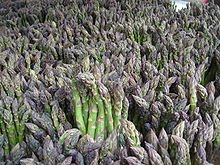
Good news (at least for me) right now. Local asparagus is here, the true harbinger of spring. I picked up some from our Farmer's Market last week, a parishioner brought me some from her own garden on Monday, and I just got another bunch of glorious, fat, purple-topped spears from the Farmers' Market again this morning. I am happier than a pig rolling in...well, asparagus.

Because my mind plays hopscotch with words, as I was looking at these pretty spears, I remembered the French word for asparagus: "asperges." Lovely, that word, so soft and lush, with the zzzhhh sound at the end, like the sigh I make when I eat perfectly prepared asperges. Asperges au gratin. Potage aux asperges. Yum.

But then I thought, "Wait! Asperges! Isn't that the word for the liturgical act of sprinkling folks with Holy Water? Aren't we going to do that at the Easter Vigil service on Saturday night?"

Of course...but what's the link between the greenish-purplish spear of vegetation that makes our urine smell funny and a holy ritual at the most powerful of our liturgies?

I remembered that the implement for doing the sprinkling of the holy water is called an aspergillum, but it doesn't look like the veggie. Those who participate in such sprinklings often use a branch of a shrub (hyssop is what is defined in Psalm 51:7 - Purge me with hyssop, and I shall be clean; wash me, and I shall be whiter than snow - as the appropriate bit of leafy sprinkler) but I wonder what it would be like to use an asparagus spear? Would this invalidate the whole act? Would we all smell a bit fetid as a result? Or are we all a bit fetid in our hearts and in need of the cleansing?

After all, asparagus was long thought of as having curative properties. Galen said it was "healing and cleansing." It is high in vitamin C and antioxidants. Perhaps it is the perfect name and the perfect tool for cleansing of body and soul.

It is unlikely, I fear, that Father Geoff and I will use asparagus on Saturday night to sprinkle holy water on the folks in the pews. More likely a sprig of boxwood, which has its own odoriferous qualities. But the cleansing of the heart will be the same, the cleansing of the soul, and it will be something more akin to the aroma of Christ (2 Cor 2:15) as we remember that we are once again saved.


Thanks, Jules, for setting my mind in gear!

Tuesday, April 19, 2011

Ummm, Time to breathe, maybe?

Holy Week: clergy::Christmas Eve:store clerks at Best Buy. Relentless, overwhelming, fraught with the unexpected.

Yeah, it's like that around here.

We had a memorial service for a dear saint on Saturday. A good Palm Sunday, with cooperative weather so we could have our procession of palms start outdoors. Hiccups with two pastoral visits: one person is in a nursing home, and has reached the point in her life that she sleeps most all the time. Our lay visitors went (I had called ahead to prepare the nurses) but the lady was asleep. They checked in later in the afternoon and found she was awake, but by the time they drove down there, she was asleep again and could not be roused. Another pair of lay visitors went to see someone whose wife (unbeknownst to us) was on the verge of death in the hospital. Husband and wife are different denominations - it gets complicated.

Last night my senior warden and I paid a visit to a family with unbloggable issues. Needed to be dealt with, but exhausting for all. Thank goodness for a fine, calm senior warden.

Today is a whole lotta sermons. Got all the ones for this week, through the Easter Vigil, done. Starting now on the Easter Sunday morning one, which will need to be special for all those folks who only come twice a year, and for all those folks who have to listen to me the rest of the time.

Our great secretary has the bulletins in good order. We're thinking ahead to the memorial service the Wednesday after Easter, and the newsletter after that. Bulletins get complicated, too, because we shift Eucharistic Prayers and Prayers of the People with the seasons.

Meanwhile, life goes on in the more quotidian ways. Lots of phone calls, pastoral visits, family stuff (preparing for StrongOpinions to graduate from Columbia and for niece to get married later next month), taking the cat to the vet for kitty chemo, unsuccessfully trying to find time for the gym.

My breathing time comes in the car, on the way to the office, when I listen to and participate in Morning Prayer via podcast. Sweetest 15 minutes of the day during this busy week.

Praying and breathing...

Sunday, April 17, 2011

Homily for Palm Sunday, 2011 “Sneak Preview”

It is spring here in Richmond. We have a few days of hot weather, just enough to convince the flowering trees and shrubs to burst forth in glorious color, and then we have days of miserable chilly damp which leaves the blossoms drooping like sad rags. We have dogwoods and camellias and now even azaleas in Crayola pinks and whites and reds. And then we have cars covered with seas of green pollen, so bad that our eyes itch and we sneeze all day long.

Then the weather turns again and the sun shines. It’s like a whipsaw. Back and forth, one way and then the other.

That is the same tension we face today in this service of Palm Sunday. Glorious spring, miserable weather. Triumphant crowds cheering Jesus’ entry into Jerusalem, strewing Palm branches on his path so that his beast of burden need not tread on mere dust. And then, suddenly, the air grows chill, the celebration is over, and Jesus is a criminal on the road to an ignominious death.

There is hardly enough time to get used to the idea of being the cheering crowd, processing into the church singing “All Glory, Laud and Honor,” before we are crying out “Crucify him!”

What happened to a gentle and graceful path from one season to the next? What happened to the calm path from the place outside the gates of Jerusalem to the Resurrection?

It’s not a calm path, of course. We know the story, both in our weather reports, one day hot, one day not, and in Jesus’ final days, one day held up as long-awaited King, the next arrested, tortured and killed.

It is a rocky and uneven path. And we know how it’s going to end, but that doesn’t make the head-snapping shift from elation to degradation and death any less painful.

Why do we hear the story of the passion today, when it is the day called “Palm Sunday?” Why do we rush ahead to the rest of the story? Can we not be granted a few days of sunshine, of the glory moment when we can celebrate our recognition of Jesus as the anointed one? Can we not be the “good guys” on this day, waving our palms to honor Jesus? Why do we have to shift the scene to the damp chill of arrest and whipping and nailing to the Cross? Our heads and our hearts snap back at the shock of it, don’t they?

One of my colleagues, on our clergy retreat on Thursday, referred to our reading of the passion narrative on Palm Sunday as something akin to a movie trailer. This is the sneak preview of what will happen over the rest of the week. Don’t get comfortable in your seats, with your palm frond tucked neatly in your prayer book or purse. Something shocking, more shocking than the latest scary movie, is going to happen, and here’s the preview.

And that’s the truth of it. We cannot get complacent in our palm-waving joy. Ours must be an ironic joy. We have to be aware of what the rest of the week brings. We have to brace ourselves for the poignant beauty of the last supper, of the institution of the meal we replicate each week at this altar, with the command to “do this in remembrance of me.” We have to force ourselves to look at the disciples dozing off as Jesus prays, to watch the horror of what is inflicted on Jesus by the powers of oppression in Jerusalem, at his broken body on the cross, with only a few brave women and one beloved disciple to stand with him at the end. We have to live in that Good Friday when the only good is the gift of Jesus’ death, an awful and awesome price paid for our souls. We have to float in that painful, liminal Saturday space, when we hurt so deeply and yet sense that something is coming that will turn our grief into amazement.

We celebrate today, but as with the change of season, we brace ourselves for the rocky path from winter to summer , a springtime with joy and pain, heat and chill, joy and sadness. We’ve seen the previews before.

Our story today is the first step on the rocky path, with a preview of what is waiting for us in the week ahead.

Wave the palm in joyful celebration, but be ready for what is to come. Come and pray this week and live into the steps of that rocky path. On Maundy Thursday, when we hear the command to love one another and to remember what Christ did. On Good Friday, when we weep and rage at what has been done to him. In expectation on Saturday, in that in-between place between grief and hope.

Then, and only then, are we ready for what Easter brings. Then, and only then, do we have the right to once again rejoice and lift our voices in hosannas. Then, and only then, does the Resurrection make sense to us.

The path is rocky, and we will walk it together, with Jesus just ahead of us. We know what to expect, and we have no excuses.

I will see you in church this week.

Amen.

Sunday, April 10, 2011

Sermon for Sunday, April 10, 2011 Ezekiel 37:1-14 “Rebuilding a Tree”

The tree guys have been here at church this week. They took down three dead or dying trees in the back, by the kitchen. In my office, I’ve been able to watch and hear their work.

It was necessary work, of course. Had those trees fallen down in a storm, they might have damaged the roof or broken windows or crushed the railing to the back staircase.

The workers were masterful. They climbed the trees with cleats on their boots that looked like rooster talons and had safety belts that secured them to the trees. They carefully roped the branches before they sawed them off, so the limbs wouldn’t fall wildly and take down a power line. Then, after all the branches were removed and either tossed into the back of the truck or sawed into smaller lengths, they began to slice off pieces of the tree, working their way down its length, until the tree was utterly deconstructed. Then they neatly stacked the pieces of sawn wood with geometric precision beside the shed out back.

There was a certain beauty to that wood. Cut, stacked, different diameters but somehow fitting together into a rough rectangle, cords of wood. In each circle of wood one could see the rings marking the years. Now all the years of the trees’ life were visible, but there was no life left in them.

Over the next few months the wood will dry out, making it useful for our fireplaces or woodstoves. For now, though, it simply sits, a pile of dead wood.

It dawned on me as I was looking at the woodpile how different that process was from the old Joyce Kilmer poem I had to memorize as a child: “Poems are made by fools like me, but only God can make a tree.”

Only God can make a tree, although some good workmen can certainly deconstruct one.

We’re much better at the deconstructing than the reconstructing, aren’t we?

We take things apart, like the men sawing apart the trees. But what if we wanted to rebuild a tree? Could we do it?

Could we take the beautifully stacked wood out the back door, figure out the jigsaw puzzle of the various pieces, restack them as they had come down? Could we glue them together again? Would that tree come back to life?

It might stand, but it would be a dead thing, a pale imitation of a living tree. The breaks made by the saws are now beyond repair, beyond regrowth. The relationship between the roots and the trunk and the branches and the buds – that pathway is severed. The sap will not flow next spring, even if we glue the pieces together masterfully.

Only God can make a tree. ..

…and only God can repair a relationship.

In a way, this is what we learn as the prophet Ezekiel talks about the meticulous work of reviving those dry dead bones.

Can these bones live? Can this tree be put back together?

It’s the same question.

The mystery of what brings life to something that is broken, seemingly beyond repair, is at the heart of Ezekiel’s vision. He finds himself in a field full of death, of broken bones. Are they the dead of Israel, the people who have gone before? Remember that the Babylonian exile was not a total one. Some of the people of Israel had been in exile in Babylon, God’s punishment for their waywardness. Some remained in Israel. The nation of God’s chosen people was torn, politically and spiritually. Could it be put back together?

This was the scene at the start of Ezekiel’s vision. A post-apocalyptic wasteland. Nothing living in sight. A vast expanse of desert, with the whole littered by bones that were out under the hot sun so long that they were bleached and utterly parched. The bones of a nation destroyed by its own hubris, the bones of Israel.

And then God’s voice, speaking to the prophet…

“Mortal, can these bones live?”

Ezekiel might have given the obvious answer, “No, they are beyond repair.”

But Ezekiel knows that God is powerful, and he does not know why he has been brought here, so he simply hands it back to God. God’s people have been humbled by their adversity, and Ezekiel has been humbled, too.

“Only you know the answer to that question.”

So God sets him at a task that on its face is an impossible one. Ezekiel is to bring these bones back to life, to call them back together into human form. With what? With words, with prophecy.

God commands the prophet to tell them that they are brought out of their graves and brought back to life by the breath and command of God, and thus too the house of Israel will be restored to life. They will return to their land. Even more important, they will know that it is God who loves them who has done this for them.

A broken relationship, like a sawn tree, like shattered bodies, put back together again like a broken watch. If you wind it, will it run?

And such strange words: “Prophesy to the bones,” as if they could hear the words Ezekiel says.

But Ezekiel, a humble prophet, does precisely what God commands. He prophesies to the bones. He tells them to knit together, to re-form into the bodies of the people of God…and like mad skeletons at Halloween they do as he proclaims. They come together. They are knit, and then they are covered with sinew, with flesh, but they are still dead things. There is no life in them. Their bodies are restored with the words Ezekiel has proclaimed, but no sap runs, there is no spark of life or soul.

Has Ezekiel failed? Or have these dead things failed to fully hear the words? Will this command fail, or will they once again live, as God has said?

So God gives Ezekiel additional instructions. “Prophesy to the breath! Call the four winds to breathe life into these creatures.” Was their sin so great, their faithlessness so deep, that it requires greater effort to repair the damage?

And Ezekiel once again cries out, proclaiming to the dead and to the winds, commanding them in God’s name. And the wind blows, winds from the four corners of the earth, wind from God’s great lungs, revivifying them, just as God’s breath into Adam’s newly formed lungs brought the first man to life. They stand. They live. Thousands, hundreds of thousands, all those who had been dead to God, dead to relationship with their creator. Given a second chance at life and at relationship because God wanted to salvage their poor desiccated bones, their sad broken souls. God wanted to restack the wood that had made up the House of Israel and cause the sap to flow again, the relationship to bloom again. God wanted them to know how great was the love he felt for them, that he would do this impossible thing…bring them back to life, back to relationship.

And six hundred years later, God did another thing to bring his wayward people back into relationship with him.

This time, it was no prophet having a mystical vision. It was something harsher by far. A man nailed to a cross, not a visionary calling to the bones and the winds. A hard price to pay, the gift of a son, for eternal life for the rest of us.

God made a choice to rebuild a relationship that was broken, broken because of our own sins, our own cupidity and hubris and desire. He could have left our bones out under the hot sun, our souls resigned to the chill of his absence. But his love was so very great that he reached out for yet another time, to repair that which was broken.

Only God can make a tree, and only God can repair a relationship.

We may think in our worst moments that we are no more than a stack of dry wood out back by the shed. We may think that there is no life in us. We may think that our own brokenness is so great that we have chain-sawed apart our relationship with the one who created us.

But I tell you this is not so. There is no brokenness that cannot be repaired. There is no chain saw that can separate us from God. God loves us too much to let us stay apart from him. The whole story of God and God’s people is a love story, of God continually reaching out to repair the damage when we in our foolishness cause a rift. God wants us to live, and to live in love with him as he is in love with us. In Lent, we remember the efforts that God has made to fix what we have broken. We remind ourselves of how God extends the hand of love over and over and over again, and Jesus as the ultimate sacrifice to ransom us from our brokenness.

And can we not learn from this, and repair the broken relationships in our own lives? Can we not reach out, as God kept reaching out for us? Can we not ask for God to breathe the breath of healing and life into that which we ourselves have injured?

God heals. God brings back to life that which seems beyond repair. God forgives. We should, too.

Amen.


Friday, April 08, 2011

Friday Five: Moving Towards Resurrection

At RevGalsBlogPals, Dorcas gives us a lovely Friday Five:

"Though I am from a non-liturgical denomination, I find myself longing for some of the expressins others of you may experience at this time of year. The same thing happens to me during Advent. At both times I am drawn to the symbolism of darkness becoming light, of longing turning to joy. One of my favorite thngs at this time of year used to be draping the wooden cross at the rear of our sanctuary with a dark purple velvet cloth and adding a crown of (ouch!) thorns--and what a lovely thing it was to see that same cross on Easter Sunday morning, draped in glowing white with a golden, jewel-studded crown added. Not being a pastor this year, I am missing some of the symnbolism I always tried to employ. I may find a nearby Episcopalian or Lutheran congregation to visit at some point, actually.

Meanwhile, today I am asking for your thoughts on that movement from darkness to light. Tell us five ways in which you are anticipating, or your life is moving towards light, joy, hope--new things: new ideas, new hobbies, new people...and so on."

I will soon celebrate a one-year anniversary at the parish that called me last year. I could not have anticipated the joys and challenges of this call, and all the ways I needed to grow to grow into it. My family, too, is moving and changing and growing.

1) toward the light of a new ministry for those youngsters who are intellectually disabled, and their families: we are starting a Christian Ed/Worship program for them, called St Giles' Gate. The exploratory committee met last night and I am so jazzed about what these folks will do for God's special children. We will do a soft launch in the summertime, then open it up to the larger community in the fall, we hope.

2) toward the celebration of my last child graduating from college. StrongOpinions will walk on May 18th at Columbia University, with a degree in Creative Writing. The world awaits her.

3) toward the addition of a new daughter in the family as son StoneMason prepares to marry the lovely Shauna sometime next year.

4) toward the stretch and creak and ache of trying to get a new free clinic off the ground in our area, a project of our interfaith clergy group in partnership with the Islamic Center. Learning curve on this project is just about vertical.

5) toward some open air and open time to play in the garden. Doug has just brought home two dogwoods and two boxwoods, plus container potting soil for herbs. Sometimes getting your hands dirty is the best way to feel resurrection in the quotidian!